 Loading AFRIMETS

An Intra-Africa Metrology System
There is an increased understanding of the importance of metrology to the economy and to society as a whole. Accurate measurement forms the backbone of technical regulations, written standards and legal metrology, thus the pre-requisite for free and fair trade between nations and citizens inside the country.
In every institute, company or other commercial organisation, concepts such as safety, security, efficiency, reliability and precision are of paramount importance in designing systems which provide guarantees of product quality. Accurate and widely accepted measurements ensure that market transactions can take place and that consumers can feel confident that the goods they buy are of the quantity and quality they require. Importantly for Africa, accurate and internationally accepted measurements allow market access for food and commodity exports.
Technological innovation depends on accurate measurements. New ideas and products often can only be implemented if accurate measurement systems are in place. At a social level, protection of the environment requires that pollutants are accurately monitored. Patients receiving medical treatment need confidence in their test results, treatment dosage and the measured ingredients of the drugs they take.
Industrial and commercial standards such as those regulated by the International Standards Organisation (ISO) create a demand for measurement. Case studies have shown that there is a strong relationship between the adoption of international standards and the extent of trade in measurement and testing equipment, proving that a good metrology system ultimately contributes to a country's GDP.
Unfortunately, the measurement system in Africa at present does not fulfil the requirements. Many countries lack basic metrology infrastructure, especially Scientific and Industrial metrology institutes. In countries with Legal metrology and/or Scientific and Industrial metrology representative bodies, there is often a lack of equipment and skills. In many instances the system operates in silos, is fragmented and is not always recognised internationally.
As a response, the sub-regions and nations of Africa came together to establish an intra-Africa Metrology System, AFRIMETS, with the main goal of harmonising accurate measurement in Africa, establishing new measurement facilities and gaining international acceptance for all measurements critical to export, environmental monitoring and sanitary and phyto-sanitary issues.
To harmonise metrology activities in Africa, an intra-Africa metrology system (AFRIMETS) was established, based on the regional metrology organisation of the Americas, SIM (Sistema Interamericano de Metrologia). The initiative is supported by the New Partnership for Africa's Development (NEPAD), the Physikalisch-Technische Bundesanstalt (PTB), the National Metrology Institute of South Africa (NMISA) and Legal Metrology at the National Regulator for Compulsory Specifications (NRCS) of South Africa.
The first AFRIMETS workshop, held in March 2006, was attended by delegates from more than 25 African countries and representatives from APMP, SIM, EURAMET, the BIPM and other interested parties such as ECOWAS, COMESA, the African Committee of Metrology (CAFMET), the South African National Accreditation System (SANAS), the Bureau of Standards (SABS) and the National Laboratory Association of South Africa (NLA).
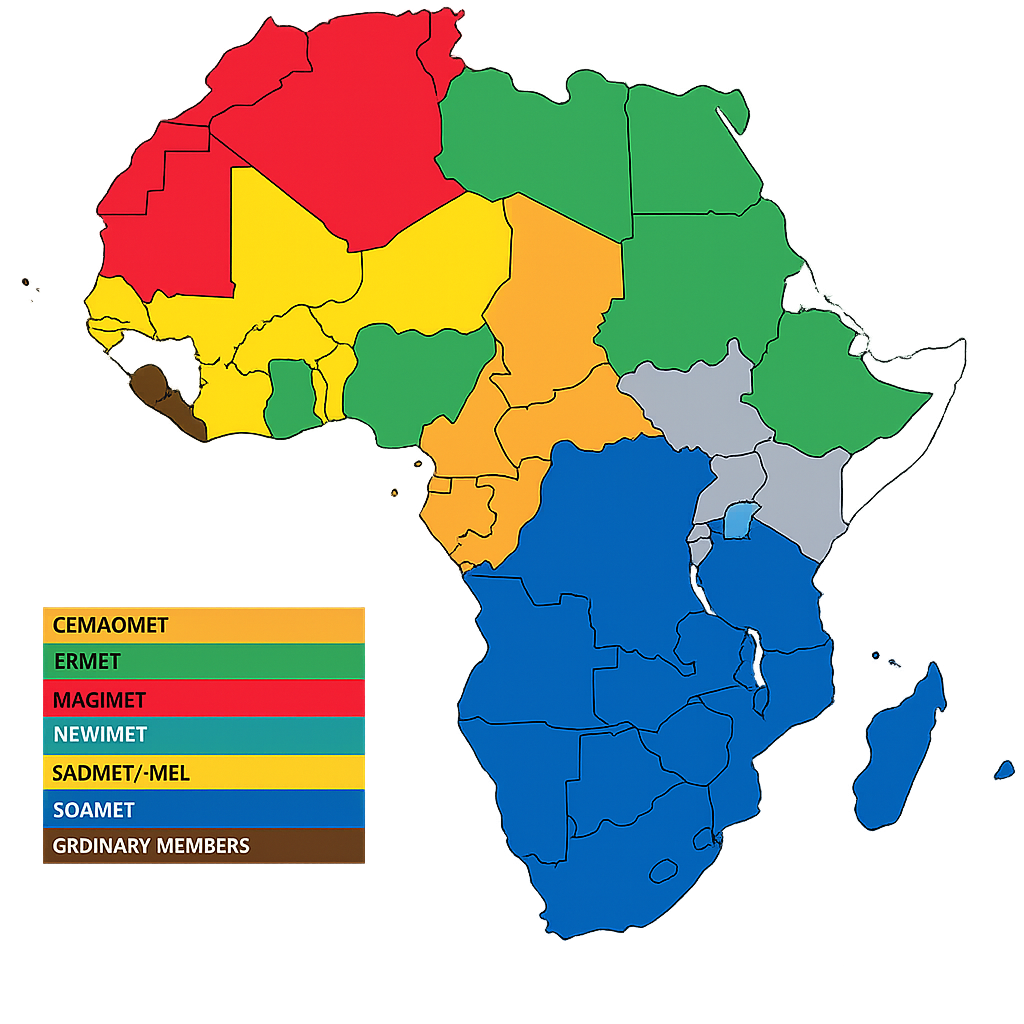
A draft MOU was prepared and a second workshop was held in September 2006. The first General Assembly meeting was held in July 2007 at the premises of NEPAD in South Africa. The MOU was finalised and signed by five sub-regional metrology organisations (SRMOs): SADCMET/MEL, EAMET, CAMET (later changed to CEMACMET), SOAMET and MAGMET, representing 37 countries in Southern, Eastern, Central, Western and North Western Africa. Nigeria, Ghana, Egypt and Ethiopia also signed on as individual Ordinary members.
Identified at the first General Assembly
Customer Objectives
- Satisfy and sensitise customers and stakeholders, including service recipients, the BIPM, African countries, NMIs, RMOs, governments, industry and consumers.
- Facilitate trade across African markets.
- Deliver value for money for measurement services.
- Increase the number and reach of services.
- Facilitate consumer protection, health, safety and environmental protection.
- Integrate the needs of members and stakeholders.
- Sensitise customers and stakeholders about international requirements.
Financial Objectives
- Reduce the cost of metrology development through the use of internal institutions in Africa.
- Sustain regional resources.
- Ensure financially strong sub-regional metrology bodies.
- Transfer traceability to end users in a cost-effective way.
- Make sure AFRIMETS becomes self-sufficient.
- Maximise scarce financial resources.
Internal Process Objectives
- Strengthen regional interactions and exchange of members.
- Harmonise regulations and policies.
- Put quality systems in place and comply with ISO 9000 and ISO/IEC 17025.
- Facilitate the removal of technical barriers to trade.
- Put in place continuous improvement strategies.
- Improve the capacity of members.
- Improve the standard of metrology.
Employee Learning & Growth
- Train people at lower cost.
- Establish databases for use by members.
- Use African experts for training.
- Become a forum for exchange between metrology organisations.
- Facilitate the technical competence of personnel.
- Share expertise and raise awareness.
- Develop world-class metrologists.
- Establish a culture of continued learning.
The second General Assembly was held in Tunisia in July 2008. All regions were represented, the MOU was updated and a work plan was adopted for 2008/2009. PTB and LNE joined AFRIMETS as the first Associate members, while EURAMET, CAFMET and the Arab Federation for Metrology joined as Observers.
In June 2009, the four Ordinary members together with Libya and Sudan formed the North-East and Western Metrology Programme (NEWMET). Its aim was to bring together the Ordinary members of AFRIMETS and provide a sub-regional metrology organisation for predominantly English-speaking countries in Africa north of the equator. Mauritania also joined MAGMET, increasing official AFRIMETS membership to 44 countries.
The third General Assembly was held in South Africa in July 2009 and included working group meetings to discuss pilot studies, proficiency testing schemes and regional key comparisons. The fourth General Assembly in Egypt, fifth in Kenya, sixth in Benin, seventh in Zambia and eighth in Ethiopia also included working group meetings.